Near field-aware UE localization paper published at AP-S/URSI 2026
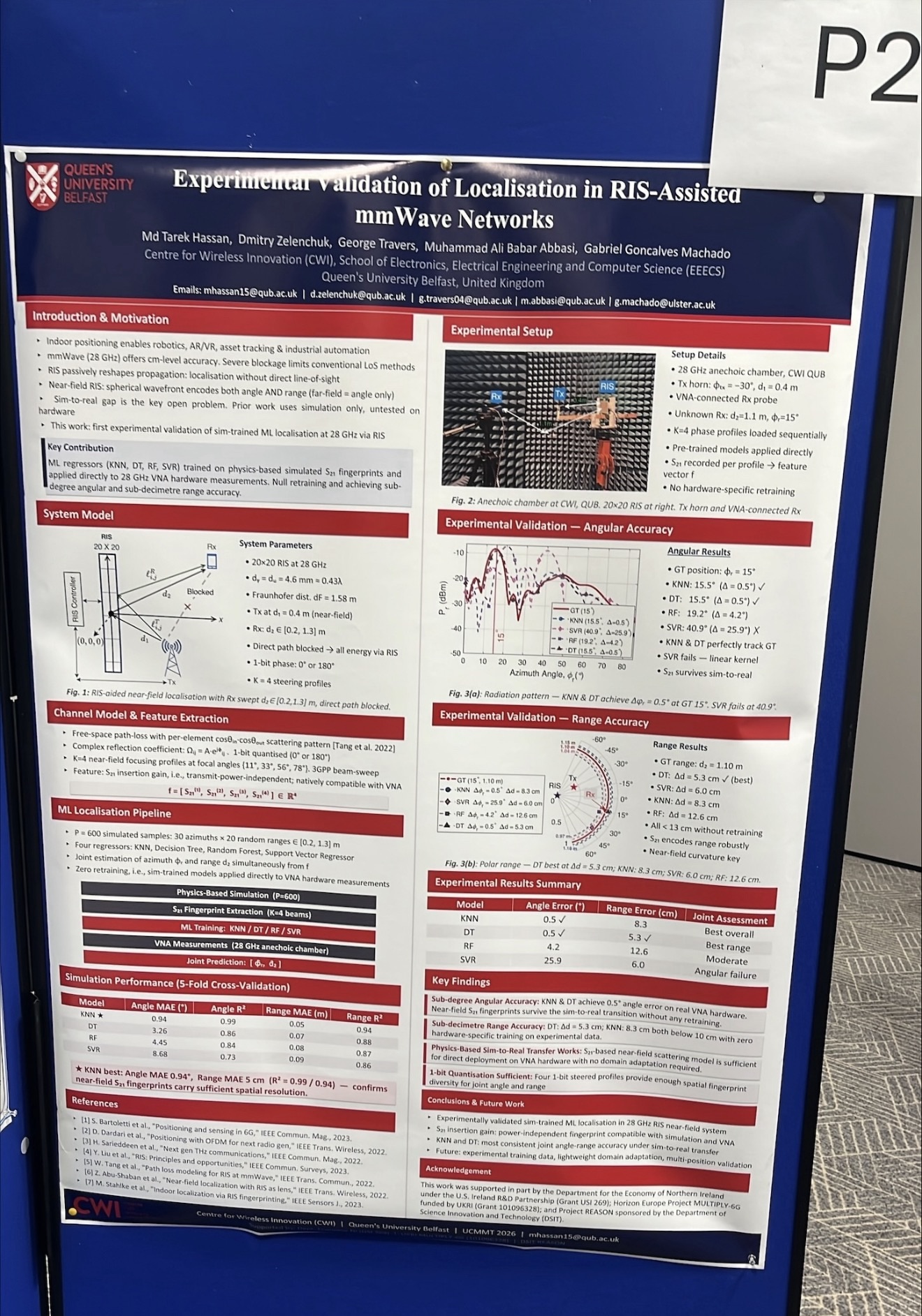
The paper “Near Field-Aware UE Localization in RIS-Aided Wireless Networks Through ML-Regressor” was published at AP-S/URSI 2026. It investigates user-equipment localization in RIS-assisted wireless environments and uses machine-learning regression to learn location-sensitive information in the near-field propagation regime.
Paper results
- Achieved a minimum ranging mean absolute error (MAE) below 4 cm at 28 GHz.
- Evaluated near-field localization with a 20 × 20 antenna array.
- Mapped SNR fingerprints from a small set of RIS beam-sweeping configurations to UE polar coordinates.
Research experience
This work strengthened my experience in framing near-field localization as a data-driven regression problem, analysing location-sensitive wireless responses, and communicating the method and findings for an antennas and propagation audience.
Next work
The next stage is to evaluate the approach with broader user positions, measured channels, and practical hardware variations to study how reliably the model transfers to realistic RIS-assisted environments.
Publication citation
M. T. Hassan, D. Zelenchuk, and M. A. B. Abbasi, “Near Field-Aware UE Localization in RIS-Aided Wireless Networks Through ML-Regressor,” in Proc. 2026 IEEE International Symposium on Antennas and Propagation and USNC-URSI Radio Science Meeting (AP-S/URSI), Detroit, MI, USA, 2026.